The Manufacturing MSME's Tender Playbook (2026)
Scaling a manufacturing firm in India requires navigating intense private sector competition, tight margins, and the constant challenge of optimizing factory capacity utilization. Beyond private contracts, the Government of India represents an alternative market where securing a manufacturing MSME tender provides a consistent, structured revenue stream.
In 2026, government departments and Public Sector Undertakings (PSUs) are spending thousands of crores on manufactured goods, ranging from heavy engineering components and electrical switchgears to office furniture and raw materials.
Crucially, these entities are mandated to allocate specific procurement quotas for the MSME sector. Under the Public Procurement Policy, central ministries and PSUs must procure a minimum of 25% of their total annual purchases from Micro and Small Enterprises (MSEs).
Yet, thousands of manufacturing MSMEs miss out because the process feels too complex. This playbook is your roadmap. It breaks down exactly how to transition from the private sector to consistently winning government tenders without the traditional administrative friction.
What Are the Strategic Advantages for Manufacturing MSMEs?
Entering the public procurement space can feel intimidating when you are competing against massive corporations. However, to level the playing field, the government has built-in specific policy advantages exclusively for registered MSMEs. Before you place your first bid, you need to know exactly how to leverage these benefits to edge out larger competitors.
1. The 25% Procurement Mandate
As mentioned, 25% of all government buying is reserved for MSEs. Within this, specific sub-targets exist for SC/ST and women-owned MSMEs. If a PSU buys ₹100 crore worth of industrial valves, ₹25 crore must come from small manufacturers.
2. Make in India (Class-I & Class-II Suppliers)
The Make in India initiative strongly favors local manufacturers over importers.
Class-I Local Supplier: Your product has 50% or more local content. You get the highest preference.
Class-II Local Supplier: Your product has 20% to 50% local content.
Non-Local Supplier: Less than 20% local content. (Often barred from bidding on tenders under ₹200 Crores).
3. Exemption from EMD and Tender Fees
Traditional bidding requires an Earnest Money Deposit (EMD), which is a refundable deposit to prove you are a serious bidder. For large tenders, this can lock up lakhs of rupees in working capital. Registered manufacturing MSMEs are completely exempt from paying EMD and tender document fees.
4. The L1 + 15% Rule
This is a key strategic advantage. If a large corporation wins a tender by quoting the lowest price (L1), but your MSME quote is within 15% of their price (L1 + 15%), the government allows you the opportunity to match the L1 price. If you agree, you can be awarded a portion of the order (often 25%).
What Documents Are Required?
The fastest way to lose a tender is through an administrative technicality, not a pricing error. Before you even log into a procurement portal, your paperwork must be absolutely flawless. To ensure you aren't disqualified on day one, here is the foundational compliance checklist every manufacturing MSME must complete:
Document / Registration | Why You Need It | Where to Get It |
Udyam Registration | The absolute baseline. Classifies you as an MSME to claim EMD exemptions and the 25% mandate. | Official Udyam Portal (Free) |
Class 3 Digital Signature Certificate (DSC) | Required to legally sign and submit bids online. You cannot file a tender without this. | Authorized Certifying Agencies (e.g., eMudhra) |
GeM Seller Profile | To bid on the Government e-Marketplace, you must have an active, verified catalog. | GeM Portal |
NSIC Registration (Optional but powerful) | Further validates your manufacturing capacity. Essential for certain PSU specific exemptions. | National Small Industries Corporation |
Product-Specific Certifications | Proves your product meets quality specs. Examples: BIS marks, ISO 9001, RDSO (for Railways). | Relevant Standards Authorities |
To ensure complete compliance:
Download our free LM-1 Mfg Tender Readiness Checklist to audit your business before you place your first bid.
Where to Find Relevant Tenders (Portal Registration & Discovery)
When most founders hear "government contracts," they immediately think of GeM. While GeM is indeed the largest marketplace, it is only one piece of a much larger procurement ecosystem. Highly lucrative manufacturing opportunities are actually distributed across more than 90 different state and central portals.
Before discovering tenders, your MSME must be registered on the platforms where the government buys. Begin by linking your Udyam certificate to create a GeM (Government e-Marketplace) seller profile. This allows you to upload your product catalog. For larger, complex manufacturing contracts, you must also register on the CPPP (Central Public Procurement Portal) using your Class 3 Digital Signature Certificate.
The Four Primary Procurement Portals
GeM (Government e-Marketplace): The primary centralized marketplace for government procurement. Best for standardized goods (furniture, standard electronics, basic machinery).
CPPP (Central Public Procurement Portal): The master portal for central government ministries. Highly detailed, complex tenders.
IREPS (Indian Railways e-Procurement System): Essential if you manufacture metal components, cables, or railway-specific hardware.
Defense Portals (MoD, DRDO): For specialized, high-grade manufacturing and R&D equipment.
The Reality of Manual Tender Tracking
This discovery phase is where many manufacturers face bottlenecks. To find the right tenders, a Tender Manager usually spends 3 to 4 hours every day opening 15 different websites, typing in keywords, and downloading 100-page PDF documents just to see if the company qualifies.
A More Efficient Approach: OpportunityX
Instead of hiring an external consultant or dedicating hours of your team's time to manual searches, OpportunityX automates this workflow. The platform scans over 90 government portals daily, matching relevant tenders directly to your specific manufacturing capabilities. What typically takes days of manual filtering is reduced to an instant alert.
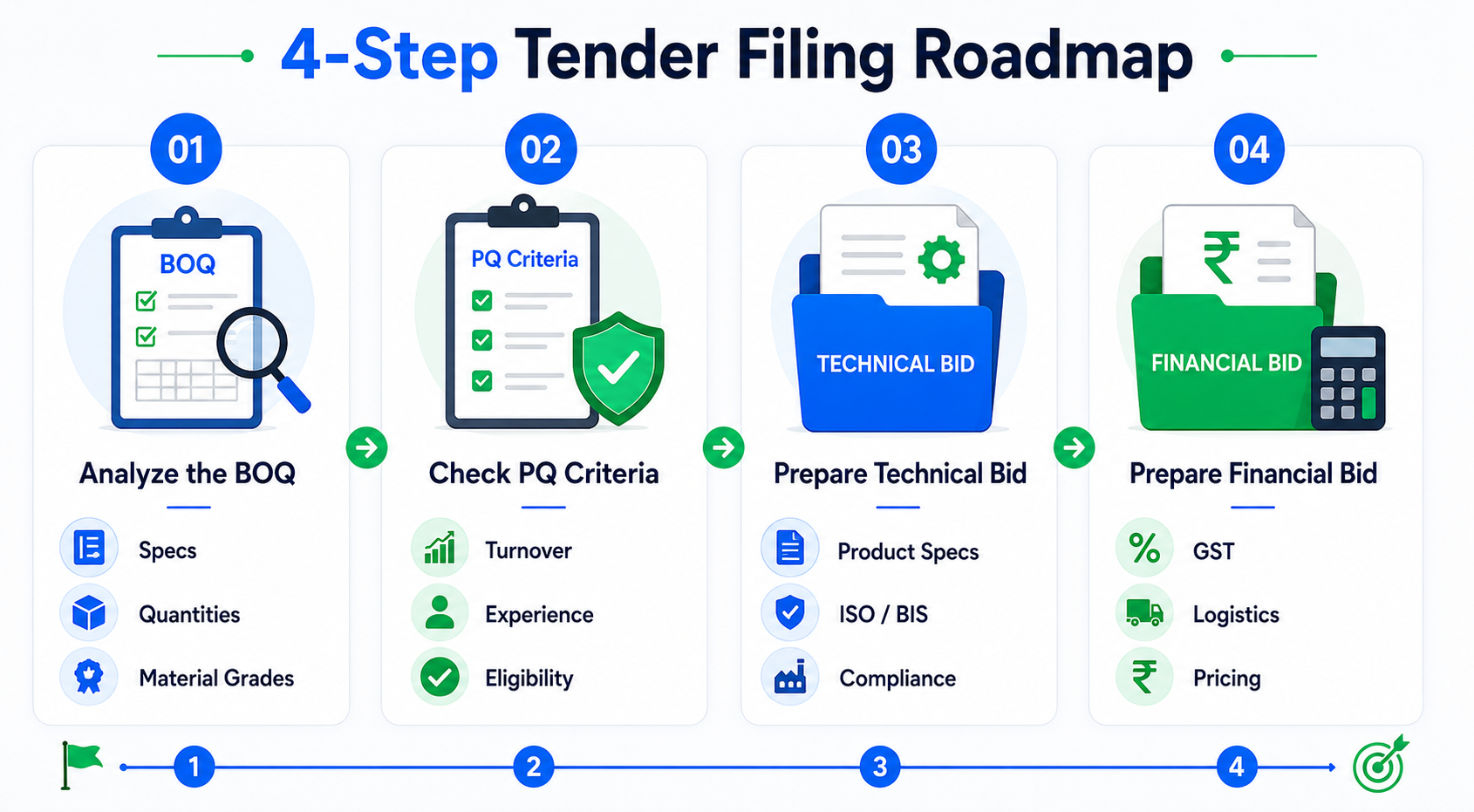
How to File a Tender: The Step-by-Step Roadmap
Finding the right opportunity is only the beginning. The actual filing process is a rigorous test of your company's compliance, capacity, and precision. To move from discovery to a successfully submitted bid, you must execute the following roadmap without deviation:
Step 1: Analyze the BOQ (Bill of Quantities)
The Bill of Quantities (BOQ) is the foundational document of your bid. It specifies the government's exact requirements, detailing technical specifications, precise quantities, and mandatory material grades. Thoroughly review these specifications before proceeding. If the tender mandates Grade 304 Stainless Steel and your quote reflects Grade 316, the bid will face immediate rejection.
Step 2: Check Pre-Qualification (PQ) Criteria
To optimize your bidding efforts, always evaluate the PQ criteria before proceeding:
Turnover Requirement: Do they require a minimum average annual turnover of ₹5 Crore for the last 3 years?
Past Experience: Do they require proof that you have supplied similar goods to a government body before? (Note: Registered MSMEs are often exempted from past experience criteria, but you must read the specific tender clause).
Step 3: Prepare the Technical Bid
Tenders are usually a two-cover system. Cover 1 is the Technical Bid. This cover demonstrates your technical capability to fulfill the contract. You will need to upload:
Technical specifications of your product.
ISO/BIS certificates.
Factory capacity certificates.
Compliance sheets verifying you meet the Make in India local content rules.
Step 4: Prepare the Financial Bid
Cover 2 is the Financial Bid. This is just your price. Remember to factor in GST, logistics (freight and insurance), and potential delays in PSU payments when calculating your margin.
Why Do Bids Get Rejected? (Common Compliance Errors to Avoid)
It is entirely possible to offer the best product at the lowest price and still lose the contract. Even highly capable manufacturers frequently face rejection due to minor administrative oversights. To protect your margins and your time, ensure your team avoids these critical filing errors:
Missing the Deadline by Minutes: Portals can experience high traffic, and DSC signatures take time to process. If the deadline is 3:00 PM, aim to submit well in advance.
Uploading Unsigned Documents: Every single page of your supporting documents must be digitally signed (or physically stamped, scanned, and then digitally signed, depending on the rules).
Wrong EMD Exemption Documents: If you are claiming an EMD exemption, you must upload your Udyam certificate in the exact slot designated for the EMD fee receipt. If you leave it blank, the system auto-rejects you.
Ignoring Pre-Bid Meetings: If a tender has a pre-bid clarification meeting, attend it. This is your only chance to ask the buyer to modify unrealistic specs before the bid goes live.
How to Fund the Execution (Managing Working Capital Constraints)
Winning the bid is an incredible milestone, but it immediately introduces a new challenge: execution. For many Founders, the reality of a massive PSU purchase order hitting their desk is quickly overshadowed by the strain it places on their existing working capital.
You need to procure raw materials immediately. But your traditional bank demands heavy collateral to increase your Cash Credit (CC) limit, or outright rejects a temporary overdraft. To make matters worse, PSUs are notorious for delayed payments, often taking 90 to 120 days to clear invoices. This creates a severe cash flow trap that can halt your factory's operations.
This is where Metal Capital provides a solution.
OpportunityX doesn't just help you win the bid; our financing arm, Metal Capital, ensures you can actually execute it. We provide low-collateral execution funding designed specifically for MSMEs supplying to government OEMs.
Fast Disbursement: Get the working capital you need to buy raw materials without the 4-week traditional bank delay.
Tender-Backed Credit: Your confirmed PSU order acts as the primary validation for funding.
Transparent APR: No hidden processing fees that eat into your carefully calculated tender margins.
How to Automate Tender Success in 2026
Filing a single government tender manually is a heavy operational lift, often requiring up to three days of dedicated administrative work. If your strategic goal for 2026 is to scale your business by winning multiple PSU orders, relying on manual tracking and data entry is simply not sustainable.
Your team should be focused on production, quality control, and sourcing raw materials. They should not be navigating complex government portals and formatting PDF compliance sheets.
This is why we built OpportunityX.
OpportunityX is India's first AI-powered tender management platform built specifically for MSME manufacturers.
Instant Discovery: Never miss a tender across GeM, CPPP, NTPC, Railways, and 90+ other portals.
Instant Eligibility Checks: Our AI reads the 100-page tender documents in seconds and tells you immediately if your factory qualifies based on turnover and past experience.
Auto-Generated Bid Documents: Generate 100% compliant, bid-ready technical documentation in just 10 minutes instead of 2 days.
Ready to Streamline Your Tender Process?
Eliminate the need for expensive consultants and manual portal searches. Take full control of your government revenue pipeline today.
Frequently Asked Questions
Yes. Under the Public Procurement Policy, recognized MSMEs and startups are frequently exempted from 'prior experience' and 'prior turnover' criteria. However, you must still prove your technical capability to deliver the specified goods as outlined in the Bill of Quantities (BOQ).
If a non-MSME quotes the lowest price (L1), but a registered MSME's quote falls within a 15% margin of that L1 price, the government allows the MSME to match the L1 price. If the MSME agrees, they are typically awarded a reserved portion of the contract, leveling the playing field against larger corporations.
No. Registered manufacturing MSMEs with a valid Udyam certificate are completely exempt from paying both the Earnest Money Deposit (EMD) and tender document fees across central government and PSU tenders.
No. Udyam is the baseline registration that officially classifies your business as an MSME, unlocking EMD exemptions and the 25% mandate. NSIC (National Small Industries Corporation) Single Point Registration is a separate, more rigorous certification that specifically validates your manufacturing capacity and offers additional benefits like exemption from Security Deposits in certain tenders. Both are highly recommended for manufacturers.
Under the MSME Samadhaan scheme, if a buyer (including government departments and PSUs) delays payment beyond 45 days of acceptance of goods, they are legally liable to pay compound interest with monthly rests to the supplier at three times the bank rate notified by the RBI. You can file a grievance directly on the MSME Samadhaan portal.
Local content is calculated as the total value of the item minus the value of imported content (including all customs duties), divided by the total value of the item, multiplied by 100. To qualify as a Class-I Local Supplier and receive the highest procurement preference, your local content must be 50% or more.

QistonPe
AI-powered tender management for Indian MSME manufacturers supplying to PSU OEMs.
Also from QistonPe: Metal Capital. Order-backed raw material financing for tender wins.
© 2026 Ambition10T Innovations Private Limited
Made in India