NSIC vs Udyam - Which Helps Manufacturers Win More PSU Tenders?
To win more PSU tenders, most manufacturing MSMEs need both registrations. Udyam is the mandatory baseline - it waives your Earnest Money Deposit (EMD) and unlocks the 25% government procurement quota. NSIC is the advanced capacity validator - it waives heavy Performance Security Deposits, which keeps your cash flow liquid on massive orders. If you only sell small, standardized goods on GeM, Udyam alone is usually enough. But if you bid on heavy engineering contracts for Railways or Defense, an NSIC certificate is critical to protecting your working capital.
Selling to the government requires perfect paperwork. For Indian manufacturers, the biggest confusion is usually between NSIC and Udyam registrations. They both help MSMEs, but they do completely different things.
Scaling your factory needs predictable revenue. Private sector margins are tight. Government orders offer massive, guaranteed volume. But you must follow their rules. Understanding NSIC vs Udyam helps you win more bids, protect your cash flow, and avoid silly rejections. For a complete strategy, see our Manufacturing MSME's Tender Playbook.
What is Udyam Registration? (The Baseline Requirement)
Udyam is your official MSME ID. It replaced the old Udyog Aadhaar system. The government uses it to pull your tax and GST data to automatically check your business size.
For any factory selling to PSUs or listing on GeM, Udyam is mandatory. It is the absolute first step in government bidding.
Key Requirements for Udyam Registration
Aadhaar Number of the proprietor, managing partner, or authorized director.
PAN Card linked to the business entity.
GSTIN (Goods and Services Tax Identification Number) active and linked to the PAN.
Bank account details (Account number and IFSC code).
NIC (National Industrial Classification) codes relevant to your specific manufacturing activities.
Before starting the online process, ensure you have the following information and documents ready. The government portal will automatically fetch your financial data based on these inputs:
The Strategic Benefits of Udyam in Tenders
EMD and Tender Fee Exemptions: Bidding usually requires an Earnest Money Deposit (EMD). A ₹10 Crore tender can lock up ₹50 Lakhs of your money. Udyam-registered businesses pay zero EMD and zero tender fees.
The 25% Procurement Mandate: Under the federal Public Procurement Policy for MSEs Order, 2012, Central Ministries, Departments, and Public Sector Undertakings are legally mandated to buy 25% of their annual requirements from qualified MSMEs.
Protection Against Delayed Payments: As per the MSMED Act, buyers must settle invoices within 45 days. Delays reported via the MSME Samadhaan Portal penalize buyers with triple the RBI bank interest rate.
The L1 + 15% Purchase Preference: Did a big company quote the lowest price (L1)? If your MSME quote is within 15% of their price, you can match it. If you do, you win a portion of the order.
Client Situation: We recently helped an industrial pump manufacturer leverage their Udyam status on the MSME Samadhaan portal against a state PSU that delayed a ₹40 Lakh payment by 140 days. Simply filing the official case triggered the buyer's finance department to clear the principal within 12 days to avoid the mandatory triple-interest penalty.
How to Register for Udyam : Step by Step Guide
Udyam registration is 100% digital and paperless.
Visit the Official Portal: Go to udyamregistration.gov.in. The official process is completely free.
Aadhaar Verification: Enter the owner's Aadhaar number. Verify it with an OTP.
PAN Verification: Enter your PAN. The system will automatically link your GST and tax returns.
Fill Enterprise Details: Add your factory address, bank details, and your correct NIC manufacturing codes.
Final Submission: Submit the form. You will get a certificate with a QR code in a few days.
Deployment Detail: When linking Udyam to a GeM seller profile, the API checks for strict PAN alignment. For a recent engineering client, an unauthorized director's PAN was used during the Udyam update, causing a continuous GeM integration failure. Always ensure the exact authorized signatory PAN on your GSTIN matches the Udyam Aadhaar/PAN link.
What is NSIC Registration? (The Capacity Validator)
The National Small Industries Corporation (NSIC) offers the Single Point Registration Scheme (SPRS). Udyam proves your financial size. NSIC proves you can actually do the work.
NSIC is not a simple online form. It requires a physical inspection of your factory by a technical agency like RITES.
The Concept of the "Monetary Limit"
The most important part of NSIC is the Monetary Limit. The inspector looks at your machines, staff, and balance sheets. They then assign a maximum capacity limit to your certificate (e.g., ₹5 Crores).
This limit caps your benefits. If your Monetary Limit is ₹5 Crores, you cannot use NSIC to waive security deposits on a ₹12 Crore tender.
Field Observation: A switchgear manufacturer we recently onboarded won an ₹8 Crore Railways tender but only held a ₹2 Crore NSIC Monetary Limit. Because their limit was too low to cover the contract size, they couldn't waive the full performance security and had to suddenly block ₹24 Lakhs in cash. Always apply for an NSIC limit enhancement before targeting larger procurements.
Key Requirements for NSIC Registration
A valid Udyam Registration Certificate.
Audited Balance Sheets and Profit & Loss statements for the last three years (signed by a CA).
Declaration of installed plant and machinery, including original purchase invoices.
Ownership documents, lease deeds, or rent agreements for the factory premises.
Valid testing and calibration certificates for all quality control equipment from NABL-accredited labs.
A detailed quality control manual outlining your production standards.
Unlike Udyam, NSIC requires an extensive portfolio of physical and financial proofs to validate your manufacturing capacity. You must prepare these documents before the physical audit:
The Strategic Benefits of NSIC in Tenders
Security Deposit Exemptions: Winning a tender often requires a Performance Security Deposit (3% to 10%). NSIC units are usually exempt from this up to their Monetary Limit. This saves massive amounts of cash.
Free Tender Sets: NSIC members get technical tender documents for free.
Institutional Credibility: Defense and Railway officers trust NSIC. A physical audit proves you run a real factory, not a shell company.
How to Register for NSIC (SPRS) : Step by Step Guide
NSIC offers huge financial waivers, so the process is strict. It takes 30 to 45 days.
Udyam Prerequisite: You must have an Udyam certificate first.
Application Submission: Apply on the NSIC SPRS portal. You must upload:
Audited balance sheets for the last three years.
Detailed lists of installed machines and purchase invoices.
Property papers or lease agreements for the factory.
Quality control manuals.
Fee Payment: NSIC charges fees. Micro-enterprises pay ₹3,000. Small enterprises pay ₹5,000. You also pay inspection fees.
Technical Inspection: An auditor will visit your factory. They will check your machines, raw materials, safety gear, and testing lab.
Certificate Issuance: If you pass, you get your certificate and your Monetary Limit. It is valid for two years.
Why Do Factories Fail the NSIC Audit ?
Many factories fail their first NSIC inspection. Based on our data at OpportunityX, factories that do a mock audit pass much faster. Avoid these simple mistakes:
Machinery Mismatch: The machines on your floor must exactly match your submitted list. Do not leave sold machines on the list.
Missing Calibration Certificates: Your testing tools must have valid NABL calibration certificates. Uncalibrated tools mean instant failure.
Inadequate Safety Protocols: The auditor wants to see fire extinguishers and proper electrical earthing. An unsafe factory will fail.
Subcontracting Discovery: NSIC is strictly for manufacturers. If you only assemble imported parts or outsource the work, you will be rejected.
Practitioner Note: During a physical audit for an auto-ancillary client last month, the NSIC inspector strictly cross-checked the serial numbers on their CNC machines against the CA-certified invoice declarations. One machine was a recent short-term rental and wasn't in the paperwork. The inspector immediately excluded its production capacity, slashing the client's final Monetary Limit by nearly 30%.
To ensure perfect paperwork before bidding:
Download our free LM-1 Mfg Tender Readiness Checklist.
What Are the Key Differences?
Here is a quick look at how both registrations compare.
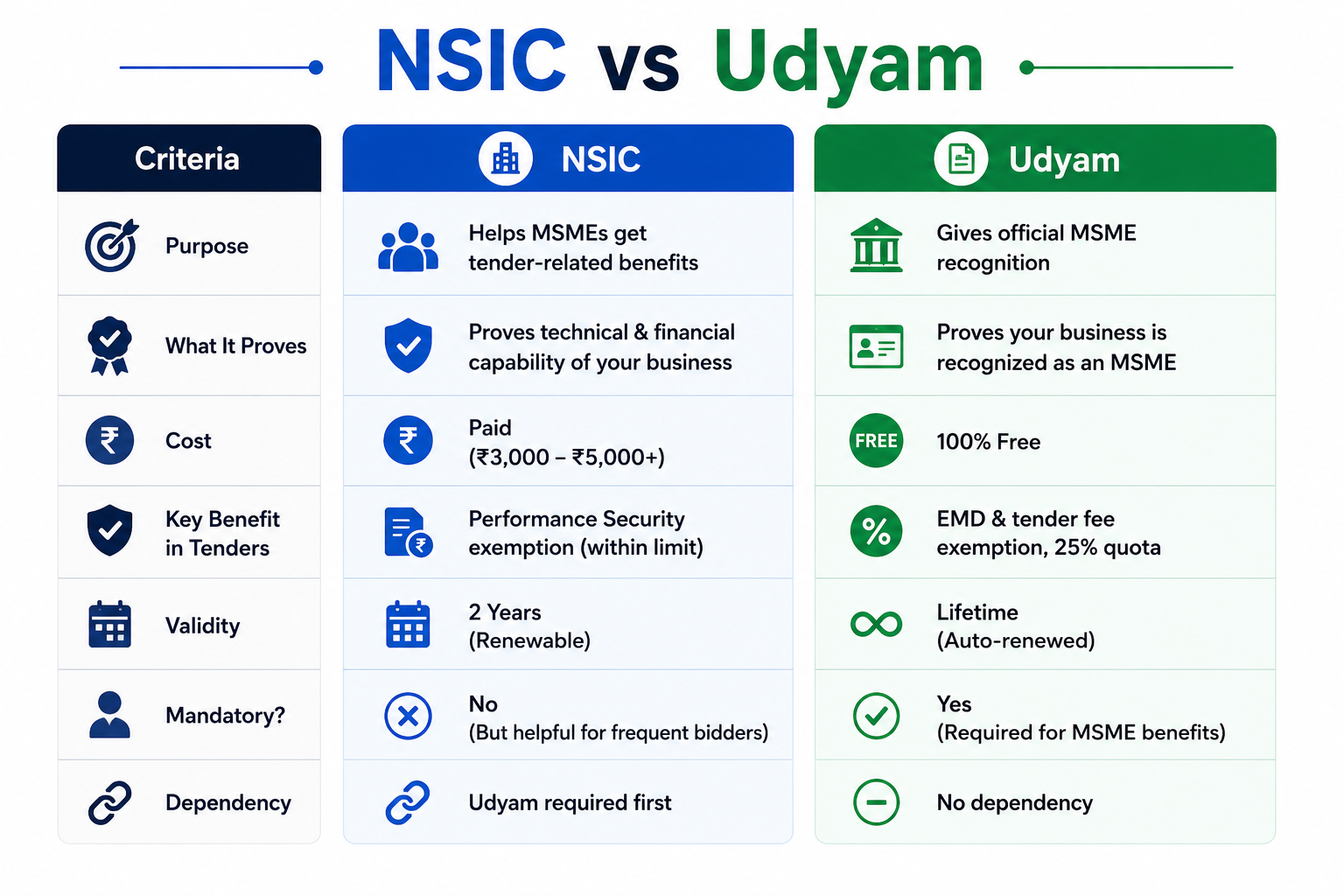
Criteria | Udyam Registration | NSIC Registration (SPRS) |
|---|---|---|
Core Purpose | Classifies your business as an MSME based on tax data. | Proves technical capacity and sets a Monetary Limit. |
Inspection Requirement | None. It is a paperless, online process. | Mandatory physical inspection of your factory floor. |
Registration Cost | 100% free. | ₹3,000 to ₹5,000+ base fee, plus inspection charges. |
Tender Benefits | Waives EMD and tender fees. Unlocks 25% quota. | Waives Performance Security Deposits up to your limit. |
Validity Period | Lifetime (auto-updates via your ITR/GST filings). | Valid for two years. Requires renewal. |
Prerequisites | Aadhaar card and PAN card. | Udyam registration is required first. |
NSIC vs. Udyam: Which Should You Choose?
Founders often ask if NSIC is worth the cost when Udyam already waives the EMD. It depends entirely on your buyer and your cash flow.
Scenario A: The GeM-Focused Supplier
Do you sell standard goods like office furniture or basic cables on GeM? Udyam alone is usually enough. GeM processes are simple. Your orders are likely smaller, so Security Deposits won't hurt your cash flow as much. Just link your Udyam ID inside your GeM dashboard.
Scenario B: The Heavy Engineering PSU Supplier
Do you make high-value parts for Indian Railways or Defense? You absolutely need both. A ₹20 Crore Railway contract might need a 5% Security Deposit (₹1 Crore). Locking up ₹1 Crore in a bank for two years will kill your cash flow. An NSIC certificate waives this deposit.
Next Steps: Scaling Your Tender Operations
Getting your Udyam and NSIC certificates is just step one. To scale your revenue, you must stop doing manual work. Searching 90+ portals, reading 100-page BOQs, and finding working capital are the real bottlenecks.
Platforms like OpportunityX automate your tender discovery and eligibility checks. Then, Metal Capital provides low-collateral funding so you can actually buy raw materials to execute the order. Combine smart compliance with automation to build a highly predictable sales pipeline.
Frequently Asked Questions (FAQ)
The NSIC registration fees vary based on the scale of your business. Currently, the base registration charge is ₹3,000 for Micro enterprises and ₹5,000 for Small enterprises. Additionally, businesses must pay physical inspection charges to the empanelled technical agency, which scale based on annual turnover. You should consult the official NSIC website for exact fee calculators based on your specific financials.
NSIC registration is not legally mandatory for MSMEs; it is an optional certification. However, obtaining it is highly recommended if you plan to bid on large government or heavy PSU tenders, as it waives expensive security deposits, increases institutional credibility, and provides access to specialized government marketing support programs.
NSIC (National Small Industries Corporation) registration is a government certification process for small-scale industries (SSIs). It physically validates a manufacturer's production capacity and grants them critical benefits, such as exemption from paying Earnest Money Deposits (EMD) and Performance Security Deposits when bidding on government tenders.
An NSIC certificate is valid for two years. Before it expires, you must apply for renewal to keep your security deposit exemptions.
No. Udyam only waives the Earnest Money Deposit (EMD) and tender fees. To waive the Performance Security Deposit, you usually need an NSIC certificate.
Yes. You must have a valid Udyam Registration Number before you can apply for NSIC certification.

QistonPe
AI-powered tender management for Indian MSME manufacturers supplying to PSU OEMs.
Also from QistonPe: Metal Capital. Order-backed raw material financing for tender wins.
© 2026 Ambition10T Innovations Private Limited
Made in India